

Soccer 101: A Beginner’s Guide
There’s never a wrong time to start watching soccer, but there is no better time than for the FIFA World Cup. And if you’re looking to join the throngs of Boston FIFA fans getting set to indulge in World Cup Boston 2026, you’ll want to know how soccer works. Thankfully, it’s a game that’s easy to pick up after one or two watches. And watching the world’s best only makes it easier. But if you want to get a head start, we’ve put together this guide to soccer rules for beginners.
How a Soccer Match Works
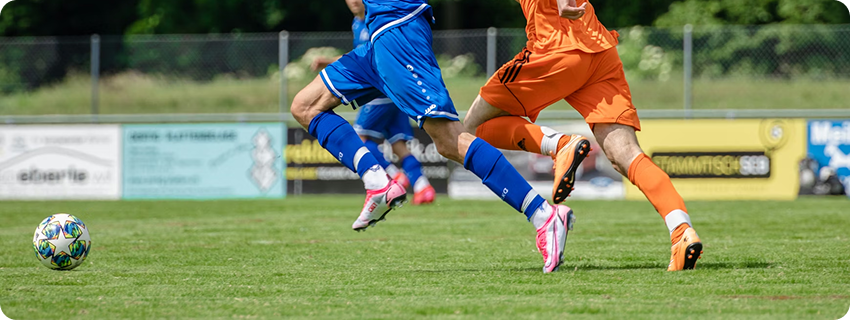
As you start watching your first World Cup Boston matches, you may start to wonder how soccer works. And by that we mean both the logistical and the cerebral—how long the match is, how to win, and what the overall flow is like. Watching the FIFA World Cup is way more fun when you know what’s going on, so here are some of the absolute basics in terms of duration, flow, and timing.
MATCH DURATION AND FLOW
A typical soccer match is 90 minutes long, split into two 45-minute halves. What sets soccer apart from the kind of football Boston Stadium usually hosts is the continuous action. The flow of a soccer game is closer to more familiar American sports like hockey or basketball. Teams move up and down the pitch, switching from offensive to defensive players as the team’s needs demand.
However, the sheer size of a soccer pitch adds an additional strategic element that informs the flow. Players move cautiously as they look for space or an open teammate to pass to. However, once they’ve found the space they’re searching for, players explode with speed to seize that gap and gain an advantage. This creates a game flow unlike any other sport.
HOW STOPPAGE & EXTRA TIME WORK
Soccer’s continuous action isn’t without slight pauses and breaks, but whatever disruptions, fans are guaranteed the full 90 minutes. When there are fouls, penalties, offsides, injuries, or a ball goes out of bounds, the clock continues to run. However, since there is no actual gameplay, that time is tracked and then added to the end of a half. This is known as stoppage time, since it accounts for the time gameplay was stopped.
Stoppage may feel like time added on to the end of a half, but don’t call it extra time because that’s its own thing. When a game is tied at the end of the regulation 90 minutes, an additional 30 minutes of time is played to decide a winner. These 30 minutes of extra time are split into two 15-minute halves to decide a winner. If the game is still tied after extra time, penalty kicks decide the winner.
How Soccer Works: The Positions

There are 11 players on the pitch for each team to start a soccer match. Whether that’s the number of players that remain on the pitch when the clock strikes 90 is a question for the refs and the players themselves—but more on that later. To better understand every second of Boston World Cup action, you’ll want to understand player roles and responsibilities.
DEFENDERS
The players outside the net can be thought of in three groups, which can and sometimes do overlap. Closest to their goal are the defenders—centerbacks, left-backs, and right-backs. These players’ primary role is to shut down the opponent’s offensive attacks and schemes. They close passing lanes, block shots, and tackle players looking to get closer to the net. They do contribute offensively as well, especially on set pieces, but more on that later.
MIDFIELDERS
Moving towards the middle of the field are the aptly named midfielders. These are typically where the playmakers, strategicians, and technical titans can be found. These players are crucial in controlling the tempo of the match. Push the ball quickly to the forwards, and you’ve got a fast-paced game. Dribble and pass laterally or backwards to slow the game down and strategize. The midfielders are constantly looking for opportunities to shift possession if on defense and start a counterattack or find the open pass or shot when on offense.
FORWARDS
Finally, closest to the opposing goal are the forwards or attack. Scoring goals isn’t the only thing on their mind, but it is their main role. These players are known for their speed and dangerous accuracy. Players like Kylian Mbappe and Erling Haaland are two of the best forwards in the game right now, and Boston FIFA fans have a chance to see their squads take to Boston Stadium for the France v. Norway match on June 26th.
GOALKEEPER
The position that can make or break a team’s FIFA World Cup hopes is the keeper. We’ll try to explain what elite goalkeeping looks like, but you’re better off joining other Boston FIFA fans to watch Scotland v. Morocco on June 19th. You’ll get to watch Morocco’s Yassine Bounou cut down on angles, create opportunities for teammates, dive to block shots, and pin the opponent deep for 90 minutes or more.
Soccer Rules For Beginners
If World Cup Boston 2026 is your first time watching soccer, fret not; no one expects you to have the full rule book memorized. While anything can happen during one of the planet’s largest sports tournaments, odds are that some of the most common fouls, cards, and penalties will occur instead.
YELLOW AND RED CARDS
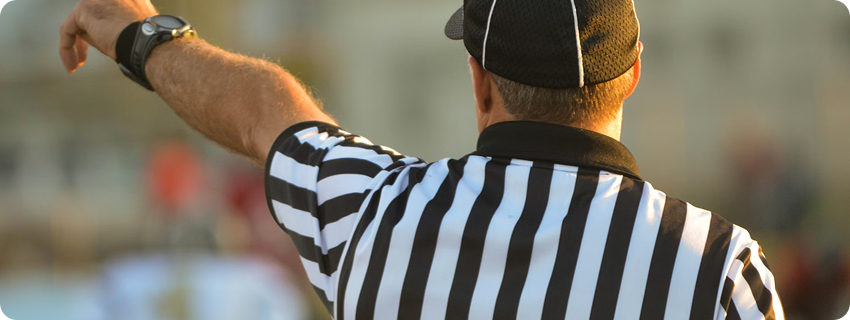
During World Cup Boston gameplay, you may hear a whistle and see a referee reach into his chest pocket to pull out one of two cards and approach a player. You’ll quickly notice the player begin to plead his case to avoid either the yellow or red card. A yellow card is a caution to a player, warning them that their conduct, whether dangerous gameplay or unsporting behavior, could land them on the bench.
Get two yellows, and that becomes a red card. A red card is when they’re actually sent off the pitch, leaving their team with one less player. A word to the wise, though, sometimes a foul or behavior may be so egregious that the yellow card is skipped and the ref goes straight for the red card.
PENALTY KICKS
Penalty kicks will decide any FIFA World Cup Boston knockout stage games that are still tied after extra time. But they can also occur during regulation after certain fouls. For example, whenever a foul that would normally result in a direct free kick occurs in that team’s penalty area (that giant box in front of the goal), their opponent is awarded a penalty kick. This is where high-powered scorers face off against keepers mano a mano from 12 yards out. It’s as thrilling a single moment as the game has, so brace yourself.
HOW OFFSIDE WORKS IN SOCCER
One common violation you’ll see—and something you’ll hear fans scream whenever their opponent scores a breakaway goal—is offsides. A player is offside when they are in their opponent’s half. Their body, head, or feet are closer to the goalline than the opponent’s second-to-last player and the ball if they get involved in the play, like receiving a pass from their teammate. In contrast, in an offside position, the official will throw the flag up and award the other team a free kick.
HOW SOCCER WORKS: SET PIECE TACTICS
When a defending team, including the keeper, knocks the ball out of play through their endline, the opponent is awarded a corner kick. These corner kicks are one of the biggest pieces of set-piece tactics in the game.
There are tons of strategies involved as players vie for position, and the player taking the corner kick decides if they want to volley a cross into the penalty area or take a more cautious approach and send something back up the pitch.

Your Complete Boston World Cup Guide
Experience your World Cup fandom to the fullest with our Boston World Cup Guide. Find great watch parties, bars, breweries, events, and more for the 2026 tournament.